 Skip to content
Moving forward from the pandemic, ecommerce businesses in particular will have to learn how to create agile supply chains that are optimized and prepared for just about anything. That’s why, in 2023, many brands and businesses are focusing on building supply chain resilience. These and other supply chain disruptions over the past few years exposed the many weaknesses in the global supply chain.
There are ways that ecommerce companies can combat supply bottlenecks. Delays, extra costs, and inconveniences that arise from bottlenecks (whether they are your fault or not) can frustrate customers, and discourage them from purchasing from your brand again. This lack of flexibility and agility can make it difficult to overcome bottlenecks — especially when those bottlenecks are the result of unforeseen and uncontrollable events, such as a natural disaster.
These questions help reveal whether the bottleneck lives in execution, visibility, or coordination rather than in isolated operational mistakes. Treating symptoms without addressing the underlying constraint may provide temporary relief, but it rarely improves long-term performance. When WMS, ERP, and partner systems aren’t tightly integrated, teams lack real-time visibility into orders and shipments, slowing throughput and increasing labor strain. Inside the warehouse, bottlenecks frequently arise from manual processes and poor system coordination. Onboarding new partners often takes longer than expected, and one-to-one integrations that work on a small scale quickly become brittle as networks grow.
Information and communication challenges
- Consider bringing production closer to consumption locations via restoring to provide a level of control that was previously unattainable.
- Low order fulfillment rates or rising lead times, for example, may signal an issue that needs to be addressed.
- These disruptions ripple through various stages of the supply chain, impacting everything from production to delivery.
- As XYZ Electronics found, an automated ERP solution that collects, compiles and centralizes data is key to effectively leveraging supply chain management data.
- Key metrics such as order fulfillment rates, lead times, and inventory turnover can provide early warning signs of potential supply chain bottleneck issues.
On the surface, the issue wasn’t inventory or transportation https://madeintexas.net/tels-global-a-reliable-partner-for-international-transport-around-the-world.html — it was data exchange. A small customer service team manually interpreted every document and keyed the data into NetSuite. When information flows through email, spreadsheets, or disconnected systems, delays and errors become inevitable.
Why Do Supply Chain Bottlenecks Happen?
Although there’s no universal solution for resolving supply chain bottlenecks, these strategies can help businesses across various industries better navigate constraints. Data alone cannot provide a roadmap for easing supply chain bottlenecks, but it can reveal meaningful insights into areas to improve. The ERP system also factors in warehouse management, inventory management, order management, transportation management and customer relationship data to provide a complete, 360-degree view of the business. But if the 3PL is already at capacity, XYZ Electronics will explore additional and/or alternative logistics solutions to fill the gaps. Rather than setting a vague objective like “speed up shipping,” XYZ Electronics first maps out its supply chain and notices that its third-party logistics (3PL) company can’t handle the increase in demand.
Yet most teams don’t have a system to detect patterns, trace accountability, or resolve efficiently. Every unresolved deduction is a lost margin and a delayed cash flow. They’re transportation and logistics bottlenecks disguised as “bad luck.” If your supplier map fits on one page, your risk profile is likely too high. Every ops lead has a story about the supplier who “overcommitted,” then underdelivered. When sales are bullish and ops are cautious, the result isn’t a middle ground.
But the causes are often more organizational than operational. It can be physical, like a port congestion issue, or digital, like a lagging invoice approval system. A bottleneck is any step in the supply chain that consistently limits the overall flow of goods, information, or revenue. And most teams are still trying to solve them using the same thinking that created the problems in the first place.
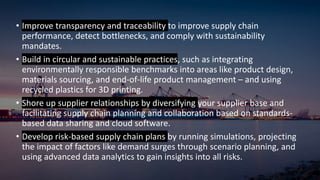
Tech enthusiasts can anticipate a wave of innovation born out of necessity, while supply chain managers shoulder the critical task of steering their companies through treacherous waters. Consider bringing production closer to consumption locations via restoring to provide a level of control that was previously unattainable. The “put not all your eggs in one basket” proverb rings especially true in supply chain management. Greater transparency throughout the supply chain allows for improved decision-making and agility. You can implement predictive analytics to enable your company to foresee potential disruptions and adjust its course accordingly. By placing all eggs in one geographical basket, companies found themselves adrift when the primary source of supplies was compromised.
The most effective approaches focus on strengthening data flow, connectivity, and visibility across the network while designing https://214rentals.com/what-types-of-transport-services-does-tels-global-provide.html processes that can adapt as volume, partners, and expectations change. While every supply chain is different, bottlenecks usually occur at the handoff points where data, inventory, or responsibility moves between systems, teams, or partners. A delay or disconnect at one point in the chain can quickly cascade into widespread issues. Book a call with our team to see how GoBolt can simplify your logistics
Complying with new requirements can slow down the movement of goods and increase administrative burdens. Changes in regulations, trade policies, or customs procedures can add complexity to supply chains. Any breakdowns or inefficiencies in these supply chain processes can lead to miscoordination, uncertainty, and decision-making delays, all contributing to bottlenecks. Factors like traffic congestion, adverse weather conditions, or logistical challenges can result in delays in deliveries and production schedules. On the other hand, having too little can disrupt production and result in missed sales opportunities. These errors often result in increased costs, customer dissatisfaction, and heightened supply chain challenges.
Warehouse Management
As we continue to trace the impact of these disruptions and the innovative efforts to overcome them, it remains clear that the traditional patterns of supply chain management are evolving. By doing so, you aren’t just managing the supply chain but are mastering it, building partnerships that can flex and flow with the changing tides. It’s important to foster closer collaborations across all levels of your supply chain, including suppliers, manufacturers and distributors.
